
HomeGuidesRainwater harvesting on a Welsh farm
Rainwater harvesting on a Welsh farm
A 450m² shed roof in mid Wales collects roughly 400,000 litres a year - about 36,000 litres a month, free, off a building you already own. Wales gets substantially more rain than England, so a UK-average calculation understates what a Welsh roof will do.
How much water will my roof actually collect?
Three numbers, and you can do it on the back of a feed bag:
Roof area (m²) × annual rainfall (m) × 0.8 = litres per year
Roof area is the footprint as seen from above - length by width at the eaves. Do not use the sloping surface; the rain falls vertically, so the plan area is what catches it.
The 0.8 is the runoff coefficient: what reaches the tank after wetting the roof, evaporation and the odd overshoot at the gutter. Profiled steel and fibre-cement sheet run at roughly 0.8 to 0.9. It is worth being conservative here - a system sized on optimistic assumptions runs empty in the dry spell you built it for.
Worked example, and use your own rainfall figure rather than this one:
| Shed roof, 30m × 15m | 450 m² |
| Annual rainfall (illustrative) | 1,200 mm = 1.2 m |
| Runoff coefficient | 0.8 |
| Collected | 432,000 litres a year |
That is about 36,000 litres a month averaged out - though not evenly, which is the whole reason for storing it.
Rainfall is the number to get right, and it is the one that varies most. Wales is wetter than England by a wide margin, and the central upland spine from Snowdonia down to the Brecon Beacons is the wettest part of it - so a lot of Powys and Ceredigion sits well above the UK average. The Met Office regional climate summary for Wales (opens in a new tab) is the place to check rather than a national figure, and your nearest weather station will beat both.
What can you use it for?
Rainwater off a roof is not drinking-quality for people and does not need to be. On a livestock farm the uses that matter are:
- Yard and parlour washdown. The obvious one, and usually the biggest single draw on mains water that does not need to be mains water.
- Livestock drinking water. Legitimate and common, given adequate filtration - and it is the largest use on most farms. On a dairy unit, drinking water is typically well over half of total consumption.
- Machinery and sprayer washing. Soft water, no scale, and it does not matter if it has been standing.
- Irrigation and polytunnels.
The saving is not only the metered water. It is the water you do not have to pump, and on holdings running off a borehole or a spring, it is the pressure taken off a source that gets tight in a dry summer - which is when you need it most and when it is least available.
Sizing the tank
The instinct is to size the tank to the roof. It is the wrong way round: size it to the gap you need to bridge.
Work out roughly what you draw in a week for the job you intend the water to do, then decide how many dry weeks you want to cover. Three to four weeks of demand is a reasonable target for washdown in most Welsh conditions - long enough to ride out a dry spell, short enough that you are not paying for a tank that never fills.
A tank far bigger than your roof can refill is a tank that sits half empty. A tank far smaller than your winter runoff spends the winter overflowing. Neither is a disaster; both are money in the wrong place.
A word on grants
Rainwater harvesting kit turns up as an eligible item in Welsh farm grant schemes from time to time. The schemes run in windows, the rules and the standard costs are rewritten each time, and there may be nothing open when you read this. So this is not the place to look for what is available; GOV.WALES rural grants and payments (opens in a new tab) is.
The one thing worth knowing in advance, because it holds across schemes and it is where quotes come unstuck: they fund a system, not a tank. Expect a minimum tank size, an entry filtration system, an overflow routed to a clean water drain, the water actually plumbed into something that uses it, and compliance with BS 8515 - the British Standard covering the design and construction of rainwater harvesting systems.
So a tank on its own does not qualify, however good the tank is. If a grant is central to whether the job happens, talk to somebody who does scheme applications for a living.
What we stock
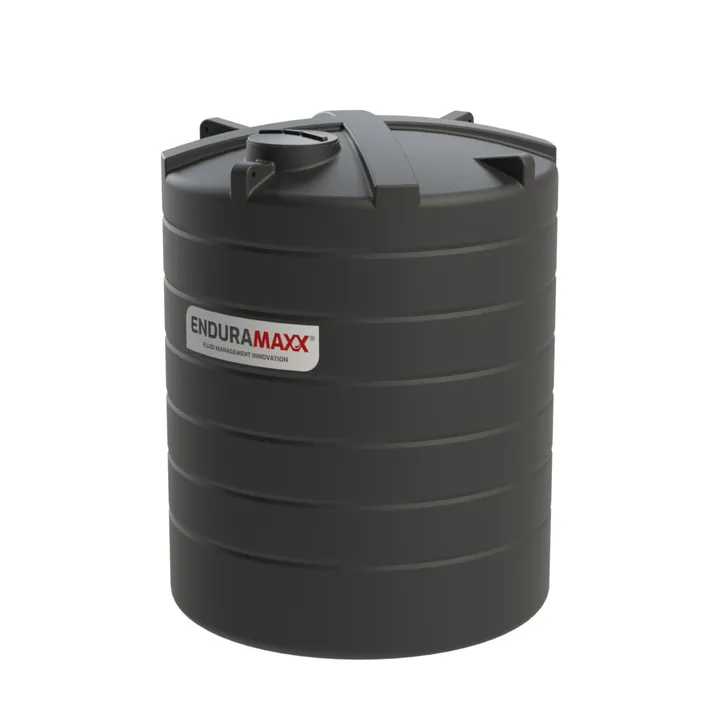
We supply Enduramaxx tanks - UK-made, one-piece rotationally moulded polyethylene, UV stabilised for standing outside, with a ten-year manufacturer warranty.
The full range is far larger than anything we would keep in the yard, so we hold the most popular sizes and order the rest. More usefully, we can put together the whole system - tank, entry filter, first-flush diverter, fittings and guttering - rather than selling you a tank and leaving you to find the parts that make it work.
If you are weighing it up, the useful thing to have to hand is the roof dimensions and a rough idea of what you would use the water for. Ring 01591 610278 or email sales@jones-agri.co.uk and we will work the numbers through with you.